
Let’s be real. Until about five minutes ago, doing anything “heavy” in a browser felt like trying to run a marathon in flip-flops. You’d open a video editor in a tab, your cooling fans would start screaming like a jet engine, and the whole thing would inevitably crash the second you tried to apply a filter.
The bottleneck was always JavaScript. It’s great for buttons; it’s hot garbage for pixels.
But things changed. Now, we have WebAssembly for real-time video processing, and it’s effectively turned your Chrome tab into a high-performance workstation.
JavaScript is the bottleneck. Wasm is the bypass.
Here’s the deal: JavaScript is a high-level language. It’s interpreted. It’s “flexible,” which is just a nice way of saying it’s slow when things get intense. When you’re talking about WebAssembly for real-time video processing, you’re talking about bypassing that sluggishness entirely.
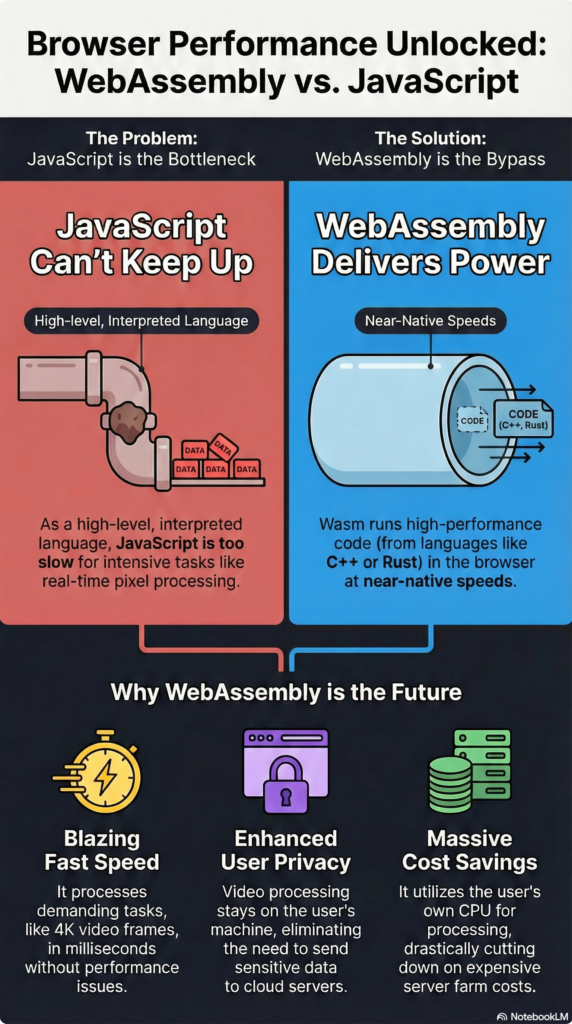
Wasm lets you take code written in C++ or Rust—the kind of languages used to build AAA games—and run it in the browser at near-native speeds. It’s not just an improvement. It’s a total teardown of the old rules.
Here’s the deal: JavaScript is a high-level language. It’s interpreted. It’s “flexible,” which is just a nice way of saying it’s slow when things get intense. When you’re talking about WebAssembly for real-time video processing, you’re talking about bypassing that sluggishness entirely.
Wasm lets you take code written in C++ or Rust—the kind of languages used to build AAA games—and run it in the browser at near-native speeds. It’s not just an improvement. It’s a total teardown of the old rules.
Why WebAssembly for real-time video processing is the only way forward
Look, if you aren’t looking into WebAssembly for real-time video processing for your stack, you’re basically building on quicksand. Why? Because users have zero patience for “buffering” icons in 2026.
- Speed, obviously: We’re talking about crunching 4K frames in milliseconds. Wasm doesn’t care about your “garbage collection” issues.
- The Privacy Angle: Using WebAssembly for real-time video processing means the video stays on the user’s machine. You aren’t shipping sensitive streams to a cloud server just to blur a background. That’s a massive win for security.
- Cost Cutting: Why pay for a massive server farm to process video when the user’s own CPU can do it for free? It’s a literal no-brainer for your burn rate.
The bottom line
But here’s the kicker: this isn’t some “future tech” that’s two years away. It’s happening right now. Companies that ignored WebAssembly for real-time video processing a year ago are now scrambling to catch up to the ones that can offer seamless, browser-based tools that feel like native software.
If it’s not fast, it’s broken. And without Wasm, you’re never going to be fast enough.
